
Hebrew rendering backwards in Claude? Here's how to fix RTL in 2 minutes with free tools
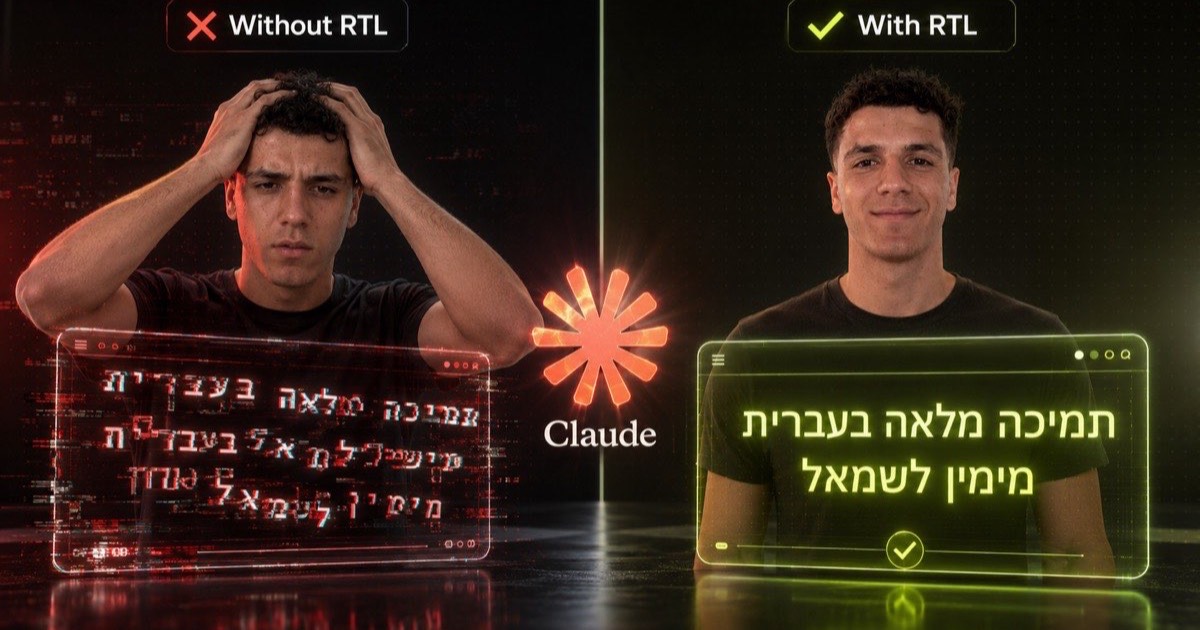
Anyone working with Claude in Hebrew knows the moment: you type a prompt, and the text jumps backwards, scrambled, aligned to the wrong side, with punctuation flying wherever it likes. This isn't a bug on your end, it's a classic RTL problem (right-to-left writing), and there are several free fixes that settle it for good.
The problem happens because many interfaces don't automatically detect that the text is Hebrew, so the rendering engine treats the line as though it were English. The moment you mix Hebrew with English words, numbers or code, the algorithm gets confused, and the result is text that's hard to read and impossible to edit comfortably.
The good news: you don't have to wait for Anthropic to fix it. Several free tools solve the whole thing. One for working in the browser, one for the Claude Desktop app (Mac and Windows), and one for coding environments. Pick whichever matches how you work; installing takes a few minutes.
Why does Hebrew text come out backwards in Claude?
The culprit is an algorithm called Bidi (short for Bidirectional), the standard every browser and operating system uses to decide which direction to display text in. By default, if an input field hasn't been explicitly set to right-to-left, the system guesses the direction from the first character. A line starting with a Latin letter or a symbol is treated as English, and all the Hebrew after it gets aligned left and sometimes displayed in reverse order.
In Claude this stands out especially when you mix Hebrew with English tool names, code snippets or links. That is exactly where the tools below come in: they force the interface to treat Hebrew text as right-to-left, align it correctly, and put the working experience back on track.
Fix 1: a Chrome extension for browser work (the simplest)
If you work with Claude through the browser at claude.ai, this is the fastest option. It's a Chrome extension that automatically detects Hebrew text in the input fields and aligns it the right way, without you touching a single setting. Install it once and it works in the background every time you type.
The big advantage is that there's no technical step here at all. You go to the extension store, add it with a click, and refresh the page. From that moment Hebrew in Claude is properly ordered. To install: link to the RTL extension for Chrome.
Fix 2: proper Hebrew in the Claude Desktop app (Mac and Windows)
If you use the Claude desktop app rather than the browser, there's a dedicated fix that switches the whole interface to right-to-left. There are two separate open-source repositories, one for Mac and one for Windows; pick the one matching your operating system.
For Mac users: go to the GitHub repository and follow the instructions in the README (the explanation file that ships with the project).
For Windows users: the quick install goes through PowerShell (the Windows command-line tool). Open PowerShell and run the following command:
irm https://raw.githubusercontent.com/shraga100/claude-desktop-rtl-patch/main/install.ps1 | iexAfter running it a UAC prompt appears (the Windows administrator permission window). Click Yes to approve. Alternatively, you can download the patch.ps1 file, right-click it and choose Run with PowerShell. All the details are in the GitHub repository.
Fix 3: proper Hebrew in coding environments and VS Code
If you work with Claude in a development environment such as VS Code (Microsoft's code editor) or in other coding agents, you need a different fix. This is where an open-source project called rtl-for-vs-code-agents comes in, which sorts out Hebrew text direction inside those interfaces. It takes a little technical understanding, but the instructions are clear.
The process is relatively simple: download the GitHub repository and follow the instructions in the README. After installing, your Hebrew in the coding environment will appear aligned and clean.
How do you install? Step by step
- Decide where you work. In the browser at claude.ai, in the Claude Desktop app, or in a coding environment. Each one gets its own fix.
- For the browser: open the extension link, click Add to Chrome, approve the install, and refresh claude.ai.
- For Claude Desktop on Mac: go to the
claude-desktop-rtl-macrepository on GitHub and follow the instructions in the README. - For Claude Desktop on Windows: open PowerShell, run the quick install command, and click Yes in the UAC window to approve administrator permissions.
- For a coding environment: install
rtl-for-vs-code-agentsper the README, and check that a Hebrew line appears right-aligned.
Which fix suits you? All the links in one place
We've collected all the fixes here with a direct link to each. Pick the one matching how you work, and you can combine several depending on context.
| The fix | What it suits | Link |
|---|---|---|
| Chrome browser extension | Working with Claude at claude.ai in the browser. The simplest, one-click install. | Download |
| Claude Desktop app for Mac | The Claude desktop app on Mac. Installed per the instructions in the README. | Download |
| Claude Desktop app for Windows | The Claude desktop app on Windows. Quick install through PowerShell. | Download |
| Code repository for VS Code | Working with Claude in a coding environment such as VS Code and in other coding agents. | Download |
Frequently asked questions
Why does my Hebrew appear reversed in Claude?
Answer: because the input field isn't set to right-to-left, and the Bidi algorithm guesses the line's direction from the first character. When you mix Hebrew with English or code, the guess is sometimes wrong and the text flips. An extension or a proper RTL setting solves it.
How do you fix Hebrew in the Claude Desktop app?
Answer: there are two dedicated open-source fixes depending on the operating system. For Mac there's the claude-desktop-rtl-mac repository, installed per the README, and for Windows there's claude-desktop-rtl-patch with a quick install through PowerShell.
Do these fixes work in ChatGPT too?
Answer: the RTL Chrome extension operates on text fields in the browser, so in many cases it will help in other interfaces as well. The GitHub repositories are focused on the Claude Desktop app and on coding environments like VS Code.
Do you need technical knowledge to install?
Answer: for the Chrome extension, no, it's a single click. For the GitHub repositories, yes, you need to download the repository and follow the instructions in the README, but the instructions are clear.
Is it safe to install an extension like this?
Answer: it's always worth installing extensions from a known source and checking the permissions they request. An RTL extension needs access to text fields only in order to align Hebrew, and has no need for access to other sensitive data.
Good luck,
TodoAI

Want hands-on help
adopting AI in your business?
At TodoAI we help organizations and business owners pick the right tool, embed it in the team, and win back hours every week.
Message us on WhatsApp
Our busy group,
tips and updates
Join the group and be among the first to hear about the hottest AI tools, tips and news, straight to WhatsApp and free.
Join the community
Create professional
podcast videos with AI
The MakePodcast platform produces short podcast videos for your brand, with your own host and your own script. No camera, no studio, no editor.
Get early accessTopics in this article
10 tags- RTL
- Hebrew backwards
- Claude in Hebrew
- RTL Chrome extension
- right-to-left text
- Claude Desktop
- VS Code
- Anthropic
- AI in Hebrew
- TodoAI