
Notion opened its workspace to Claude: how to connect an AI agent that sits inside your team
It was only a matter of time before Notion connected its workspace to external AI agents. On 13 May 2026 it happened. The 3.5 release brought the External Agents API, and there is now an official connection to Claude. If you use Notion and have until now kept a separate tab open every time you needed something from Claude, that changes for you.
The feature is still in alpha (an early trial version, before beta), but anyone who has used Notion as an organizational knowledge system or a project-management hub will feel the difference from day one. An AI agent that until now was a guest in a single column or a separate add-on now sits inside the workspace, gets mentioned with @, and receives permissions to work on pages and tables like any other team member.
This isn't just a technical change, it's a conceptual one. The workspace becomes a hub for AI agents, not just a collection of static pages.
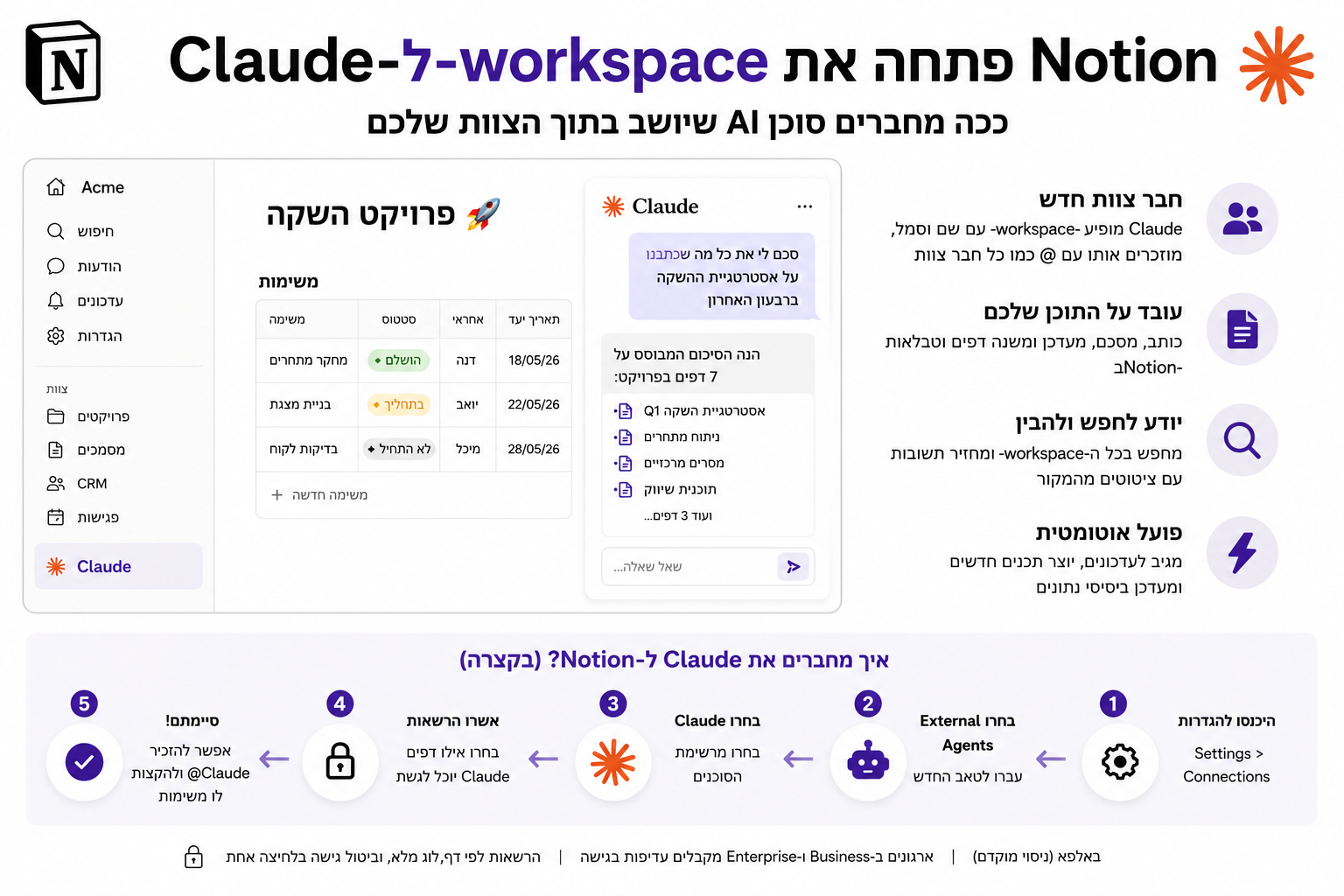
So what actually changed in Notion 3.5?
Until 13 May 2026 the story was simple. Wanted Claude to read and write in Notion? You had to set up MCP (Model Context Protocol, an open protocol connecting LLMs to external tools), enable OAuth (an authentication protocol), and connect Claude Desktop to your Notion token. It worked, but it was messy and technical.
With the External Agents API, Notion made that connection an official part of the system. The agent gets an identity with a name and an icon inside the workspace, permissions are configured just as they are for a regular user, and every action it takes is recorded in the admin log the team manager can review.
Beyond the External Agents API, Notion added three further capabilities in version 3.5:
- Notion Workers: a managed code environment on Notion's infrastructure, for running custom actions without maintaining a server. Works together with the External Agents API.
- Database Sync: automatic syncing of external databases into the workspace, with no code.
- Notion CLI: a command-line tool for coding agents and developers who want to build further integrations.
How is this different from Notion's existing MCP connector?
MCP is the open standard Anthropic launched for connecting LLMs to tools. Before 13 May, if you wanted Claude to work in Notion, you'd run Notion's MCP server and connect it to Claude Desktop. That worked well for a single user, and less well for a whole team.
The External Agents API differs on three main points:
- The agent is visible inside the workspace. It isn't only behind the scenes. It participates with a name and an icon like a team member.
- Unified permission management. Instead of two separate places (Notion and Claude Desktop), everything is managed from within Notion itself.
- Team behavior. You can mention the agent with @, assign it an item in a database, and get a notification when it's done.
This doesn't mean you should throw MCP away. The two live alongside each other, and there are situations where each is preferable. It is worth noting that the External Agents API is currently in alpha, while MCP is stable.
How do you connect Claude to your Notion? Step by step
- Open Notion on desktop or on the web, and open your workspace.
- In the side menu click Settings, then Connections. You'll find a new tab called External Agents.
- Choose Claudefrom the list of available agents. You'll be taken to Anthropic's authentication (OAuth) page.
- Approve the connection. Notion asks which pages and permissions you're granting the agent. Use the page pickerand select only what's needed, no more.
- Done. You can now mention
@Claudeon any page or database, and assign it an item in a task.
Important note: the External Agents API is in alpha, which means you need to join a waitlist at notion.com/product/dev. Organizations on Notion Business and Enterprise get priority access.
What can Claude do inside Notion?
- Write document drafts inside a page you open, with memory of the entire workspace it's connected to.
- Summarize a project across several pages and save a new summary to a separate page, with links back to the source.
- Update database fields (status, date, owner) based on input you give it in conversation.
- Search the whole workspace and return answers quoted from the original page, not guesses.
- Act automatically when an item is updated (for example: a new client is added to the CRM, and Claude generates a budget card on another page).
It all works natively in Hebrew RTL (right-to-left writing), in both text and tables, with no machine translation and no broken layout.
Table: External Agents API vs MCP vs a regular connection
| Capability | Regular connection | Notion's MCP | External Agents API |
|---|---|---|---|
| Appears inside the workspace | No | No | Yes, as a team member |
| Permission management | General read or write | OAuth + token | Notion's built-in UI |
| Automatic triggering | No | Partial | Yes, via Workers |
| Suitable for an organization | Less so | Mainly for developers | Yes, knowledge workers too |
| Maturity | Stable | Stable | Alpha |
Does this change your whole organizational knowledge system?
If Notion is where your team manages knowledge, then yes: the new API opens a door that wasn't there a fortnight ago. An AI agent goes from being a "tool on the side" to a participant in the daily routine of knowledge workers.
A typical scenario: a mid-sized organization holding 800 pages in Notion (methodologies, protocols, open threads, client records) has until now depended on the one person who knows where every document is. With Claude as an external agent, any employee can mention @Claude on a page and ask: "Summarize everything we've written about B2B client SLAs (service level agreements) in the past year." The answer comes back with citations from 7 pages within seconds.
For your knowledge workers, that means less time hunting for documents and more time making decisions. For the workspace admin, it means full control over who sees what, with a log of every action the agent took.
Frequently asked questions
Is the External Agents API available to all accounts?
Answer: currently in alpha (an early trial version). There's a waitlist at notion.com/product/dev. Organizations on Notion Business and Enterprise get priority.
Do we need to cancel the MCP connection we have now?
Answer: not necessarily. The two solutions can live side by side. MCP suits individual use from Claude Desktop; the External Agents API suits sharing across a team.
Does it cost extra?
Answer: the connection itself is free, but actions performed through Notion Workers consume Notion Credits on your subscription ($10 per 1,000 credits). Claude usage comes out of your existing Anthropic subscription.
Is it safe for an organization?
Answer: yes. Permissions are set per individual page or database, there's a full log of every action, and access can be revoked in one click. The agent gets only what the workspace admin has explicitly approved.
Good luck,
TodoAI

Want hands-on help
adopting AI in your business?
At TodoAI we help organizations and business owners pick the right tool, embed it in the team, and win back hours every week.
Message us on WhatsApp
Our busy group,
tips and updates
Join the group and be among the first to hear about the hottest AI tools, tips and news, straight to WhatsApp and free.
Join the community
Create professional
podcast videos with AI
The MakePodcast platform produces short podcast videos for your brand, with your own host and your own script. No camera, no studio, no editor.
Get early accessTopics in this article
10 tags- Notion
- Notion External Agents API
- Claude
- Claude in Notion
- AI agent
- enterprise automation
- knowledge management
- Anthropic
- Notion 3.5
- TodoAI